
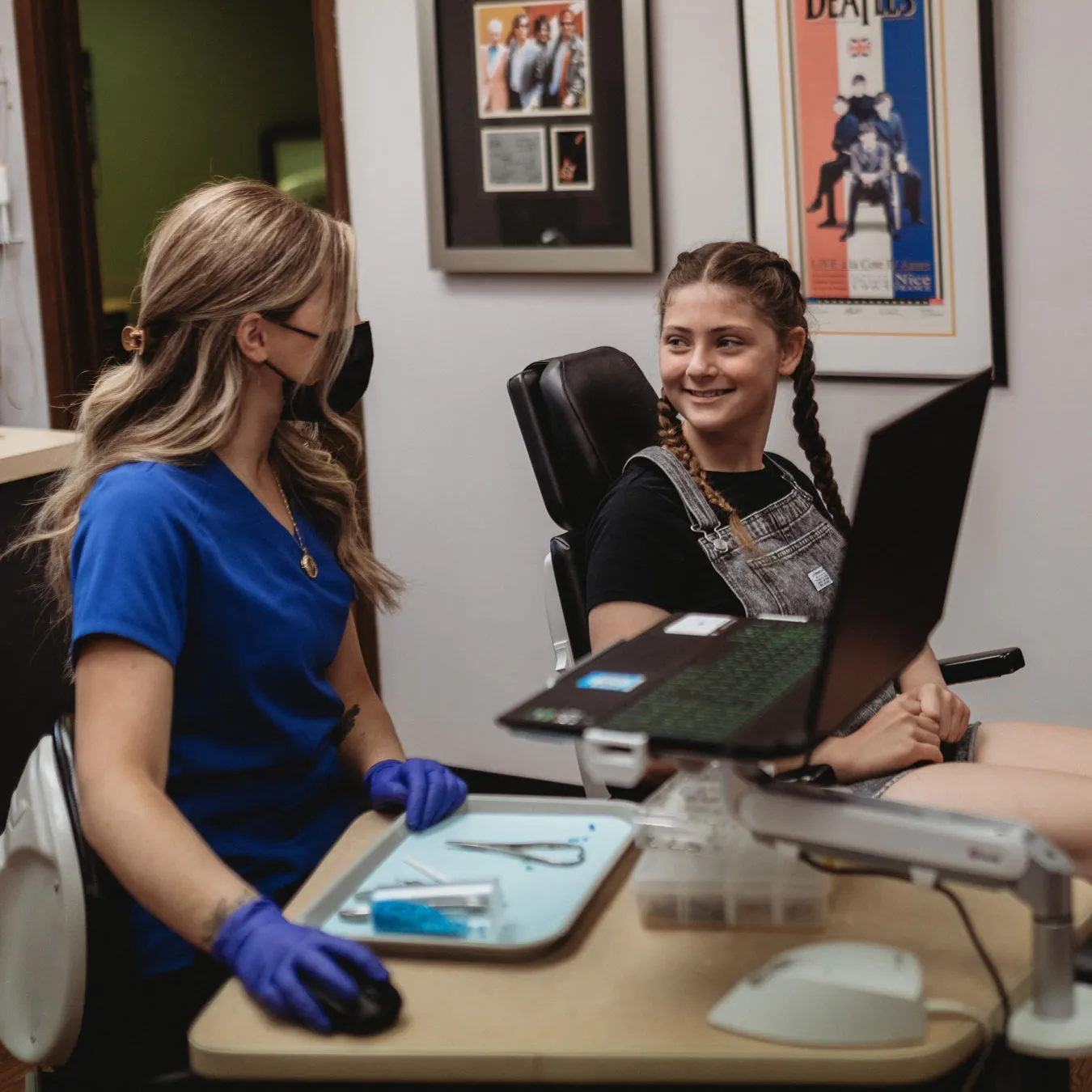
Dentists handle your overall oral health. Orthodontists specialize in straightening teeth and fixing bite problems. That’s the main difference, and it’s the one that matters most when you’re trying to figure out who to call about a dental concern.
What’s the Difference Between an Orthodontist and a Dentist?
A dentist provides general oral health care, including cleanings, fillings, and preventive care. An orthodontist is a dentist who completed two to three additional years of residency training specializing in tooth alignment and bite correction. Think of it like the difference between a family doctor and a heart specialist.
Every orthodontist starts out as a dentist. They finish dental school just like your family dentist, then keep going with focused residency training in tooth movement, jaw positioning, and bite correction. Both are doctors, but one has that extra training for specific conditions.
Your dentist takes care of cleanings, fillings, crowns, gum health, and cavity prevention. An orthodontist focuses on alignment issues like crooked teeth, crowding, gaps, overbites, underbites, and crossbites. Board-certified orthodontists, like those who are members of the American Association of Orthodontists, meet rigorous standards that demonstrate their expertise. At Romick Orthodontics, Dr. Romick is a rockstar orthodontist with this kind of specialized, residency-trained background.
What Does Each Provider Actually Do?
Knowing what happens at each type of appointment helps clarify which provider you need. The short version: your dentist keeps your teeth healthy, and your orthodontist gets them lined up right.
Your dentist handles preventive and restorative care:
- Regular exams and X-rays to catch problems early
- Professional cleanings to remove plaque and tartar
- Filling cavities and treating tooth decay
- Crowns, bridges, and other restorations
- Tooth extractions when necessary
- Gum disease prevention and care
- Screening for oral cancer and other conditions
A rockstar orthodontist diagnoses and treats alignment issues:
- Evaluating how your teeth fit together when you bite
- Identifying jaw growth patterns in kids and teens
- Custom plan using braces, clear aligners, or other appliances
- Correcting crowding, spacing, and bite problems
- Tracking tooth movement throughout the process
- Retainers to lock in your results
During routine checkups, your dentist may notice alignment or bite issues and recommend you see an orthodontist for an evaluation. Many cases work best when both providers collaborate. Your dentist keeps your teeth healthy while the orthodontist works on positioning them correctly. It’s a team effort, and a good one at that.
Benefits of Seeing a Specialized Orthodontist
The main benefits of seeing an orthodontist include specialized training in tooth movement, access to advanced diagnostic tools like digital scans and 3D imaging, and better long-term outcomes for alignment and bite cases. These factors lead to more accurate diagnoses and results that last.
Why Does Specialized Training Matter?
Orthodontists spend years studying nothing but tooth movement and jaw development. That focused expertise means they handle complex cases that go beyond basic straightening. They understand how teeth, bones, muscles, and joints all work together, which matters when the fix isn’t as simple as shifting one tooth over.
Here’s what that looks like in practice:
- Your orthodontist can identify underlying jaw and skeletal issues, not just surface-level tooth positions
- Digital scans and 3D planning replace those gross and messy molds, and give you a clearer picture of your results
- You get better long-term outcomes because specialists see these cases every single day
- Options that fit your life, from traditional braces to clear aligners
You might not notice these benefits right away. But a year from now, when your bite is solid and your teeth haven’t shifted? That’s when it clicks.
When Should Children Get Their First Evaluation?
Children should have their first orthodontic evaluation by age seven, according to the AAO. At that age, a board-certified orthodontist can spot developing problems and determine the best time to get started if needed. Early orthodontic evaluations catch issues while a child is still growing, which often means simpler and shorter care down the road. The AAO reports that roughly 1 in 4 orthodontic patients could benefit from interceptive treatment before all permanent teeth come in.
Orthodontist vs. Dentist: Side-by-Side Comparison
The main differences between a dentist and an orthodontist come down to education, focus, and the types of procedures each one performs. Dentists provide lifelong preventive care across your whole mouth, while orthodontists concentrate on how your teeth and jaws line up, typically over a defined care period.
| Factor | Dentist | Orthodontist |
|---|---|---|
| Education | 4 years dental school | 4 years dental school + 2-3 years orthodontic residency |
| Focus | Overall oral health | Tooth alignment and bite correction |
| Common Procedures | Cleanings, fillings, crowns, extractions | Braces, clear aligners, retainers, jaw appliances |
| Visit Frequency | Every 6 months for checkups | Every 4-8 weeks during active care |
| Treatment Timeline | Single visits or short-term care | Months to years depending on complexity |
| Ongoing Relationship | Lifelong preventive care | Active care phase plus retention |
One thing that surprises many patients: you don’t stop seeing your dentist when you start orthodontic care. Regular dental cleanings and checkups continue throughout your time in braces or aligners. Your teeth still need cavity prevention and professional cleaning, even while they’re being straightened.
Cost Considerations: Dental Visits vs. Orthodontic Care
Orthodontic care typically costs more than routine dental visits because it spans months to years and involves specialized appliances and ongoing adjustments. Dental cleanings and exams are usually covered by insurance with predictable copays. You budget for those twice-yearly visits as part of normal healthcare maintenance.
Orthodontic care is a different story financially. The total investment reflects a longer timeline, and according to the American Association of Orthodontists, most orthodontic care in the U.S. falls in the range of $3,000 to $7,000 depending on the type and length of care. The good news? Many dental insurance plans include orthodontic benefits that help offset costs. Romick Orthodontics also offers low monthly payment options that make care accessible for more families.
Smart ways to approach orthodontic costs:
- Check your insurance benefits for orthodontic coverage
- Ask about low monthly payment options that spread costs over your care
- Interceptive treatment for kids may prevent more involved care later
- Take advantage of free consults to understand your specific investment
Signs You Should See an Orthodontist Instead of a Dentist
You likely need an orthodontist if you have crooked teeth, crowding, gaps, or bite problems like overbite or underbite. See a dentist for cleanings, cavities, and general oral health. If you’re unsure, your dentist can refer you.
Here are clear indicators that an orthodontist should be your next call.
Appearance concerns:
- Teeth that are crooked, crowded, or overlapping
- Noticeable gaps between teeth
- Teeth that stick out or sit too far back
Bite problems:
- Upper teeth that extend too far over lower teeth (overbite)
- Lower teeth that sit in front of upper teeth (underbite)
- Upper and lower teeth that don’t meet properly on the sides (crossbite)
- Front teeth that don’t touch when back teeth are together (open bite)
Bite issues aren’t always obvious just from looking in the mirror. Sometimes the first clue is a functional problem you’ve been living with for years.
Functional issues you might not expect:
- Trouble chewing food thoroughly
- Jaw clicking or popping sounds
- Headaches that may be connected to bite alignment
When to bring your child in:
- Your dentist recommends an orthodontic evaluation
- You notice crowding as adult teeth come in
- Your child has trouble chewing or biting
- Thumb sucking or other habits have affected tooth position
- Your child is seven or older and hasn’t had an initial screening
Even if everything looks fine, that first evaluation around age seven gives a rockstar orthodontist the chance to monitor jaw growth and catch developing issues early. At Romick Orthodontics, we’re happy to take a look and create a monitoring plan if needed.
Frequently Asked Questions
Can a dentist do braces, or do I need an orthodontist?
Technically, some general dentists offer basic orthodontic services. But orthodontists complete two to three extra years of specialized residency training in this area, so for anything beyond minor alignment issues, seeing a specialist typically produces better results.
Do I still need to see my dentist while wearing braces or aligners?
You bet. Regular dental checkups and cleanings should continue throughout orthodontic care. Keeping teeth clean is even more important when you have braces since food can get trapped around brackets and wires. Your dentist and orthodontist work as a team for your oral health.
At what age should my child first see an orthodontist?
The AAO recommends an initial evaluation by age seven. That doesn’t mean care starts that early for most kids. It simply allows the orthodontist to monitor development and identify the ideal time for care if it’s needed.
Can an orthodontist do cleanings and fillings?
Nope. Orthodontists focus exclusively on alignment and bite correction. You’ll continue seeing your regular dentist for cleanings, fillings, and other general dental procedures while receiving orthodontic care.
Do I need a referral from my dentist to see an orthodontist?
Most orthodontic practices, including Romick Orthodontics, welcome patients without a referral. You can call directly to request a free consult. That said, many people first learn about their alignment issues from their dentist, who then recommends they see an orthodontist for evaluation.
Curious what a rockstar orthodontist would recommend for you or your child? All you’ve got to do is start. Request a free consult to understand your options and find out what orthodontic care might look like. A good smile is on the way.